
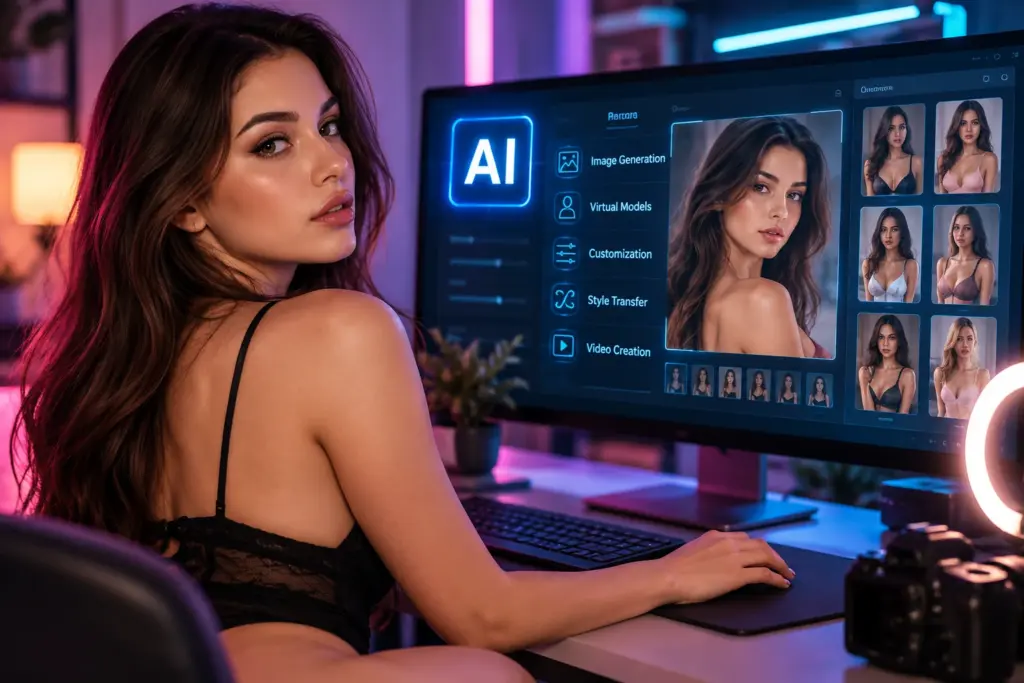
Adult content has always followed the cheapest available production method. Magazines gave way to videotapes, tapes to streaming, and streaming to creator platforms where one person handles filming, editing, and billing. Generative AI is the next step in that sequence, and it differs from the earlier ones because the finished image or clip no longer needs a camera, a set, or a performer at all.
The change is already visible in how platforms describe themselves. Instead of listing performers or studios, they list styles, character types and customization options, and the product on offer is the generator rather than any single piece of content.
A conventional shoot involves casting, scheduling, location costs, release paperwork, and post-production. A generated scene replaces most of that with a written description and a few minutes of compute time. The creator still makes decisions about look, setting, and mood, but those decisions are expressed as words and settings instead of a crew call sheet. Iteration changes as well. Reshooting a scene means rebooking people, while regenerating one means pressing a button again.
Lovescape sits in the ai porn xxx niche, where it packages that process as a character builder with chat attached. The user picks a style, adjusts appearance and personality, and then generates images, voice, or short video around the same fictional character.
Quality control shifts too. A photographer checks a frame on set, while a generator user checks the output after it exists, discards the weak ones, and keeps the best. Volume replaces planning as the main tool, which is why generation speed and cost per image matter so much on these platforms.
Performers worry about substitution, and the concern is reasonable. If a fictional character can be produced at near-zero marginal cost, rates for stock-style material will come under pressure. The work that is harder to automate is the part built on a real person’s identity, such as a creator’s personal brand, direct messages with subscribers, and live sessions. Those depend on authenticity, which a generated persona does not claim.
Independent artists and writers sit on the other side of the change. A small studio or a solo illustrator can now produce a consistent cast of characters, backgrounds and short scenes without hiring a team. Writers use the same tools to storyboard before commissioning final art. The gap between a hobbyist’s output and a studio’s output narrows, and competition shifts toward concept, voice and community instead of production budget.
Sharing tools are appearing as well. A user who builds a character can make it available to others to talk to, which turns customers into contributors and makes the library, rather than any single image, the product.
Rights and revenue deserve attention as well. Contracts for performers written before generative tools existed rarely address whether a likeness or a voice can be used to train a model, and several industry bodies have pushed for explicit consent and compensation clauses. Creators who sell content online should read platform terms for any licence that lets the service reuse uploads for training.
Audience expectations are still forming. Some viewers care that a person was involved, and others care only about the result. Labels such as AI-generated let each viewer choose, and platforms that apply them honestly avoid the backlash that follows when synthetic material is passed off as a real performance.
Investment figures show how seriously the underlying technology is being funded. Stanford’s AI Index reports that private investment in generative AI reached 33.9 billion dollars in 2024, an increase of 18.7 percent on 2023 and more than eight and a half times the 2022 level. Adult applications are only a slice of that activity, but they use the same image and language models the larger funding rounds pay for.
Cheaper, faster models flow down to every category of application at once. When an image model improves at rendering hands or skin texture, an adult character generator gets the improvement the same month as a design tool or a game studio does. For readers following the sector, quality gains arrive from general research and not from anything specific to adult content, so platforms compete mainly on interface, moderation, and how much control they give the user.
Cost curves matter more than headlines. Falling prices for image generation have made it viable for small teams to run a service with thousands of users, which would have required a studio budget a few years earlier.
The most useful property of a fully fictional character is that no real person’s body or face is involved. That removes the consent problem that haunts earlier synthetic media, where a real individual’s likeness was copied into material they never agreed to. Responsible platforms state that every depicted character is an AI-generated adult and prohibit uploads of real people’s photos for generation. Users should look for that policy in writing.
Enforcement is the weak point. A model trained on scraped images can reproduce a recognisable face by accident, and a determined user can try to steer a prompt toward a real person. Platforms that take the issue seriously run filters on prompts and outputs, block the names of public figures, and offer a reporting channel. Their absence is a reason to look elsewhere.
Documentation helps. Some platforms publish a short statement on how characters are created, which sources feed their models, and how complaints about likeness are handled. A user cannot verify every claim, but a platform willing to describe its process in writing is easier to hold to account.
Regulation is catching up with the technology. Several countries have tightened age verification for adult sites, and labelling rules for AI-generated media are being written in more than one jurisdiction, with the aim that viewers can tell a synthetic image from a photograph.
For a platform, the practical work is gating access to adults, keeping records of how each character was produced, and giving users a clear way to delete their data. For a reader choosing between services, the questions are simpler. Is the site open about being adults only, does it describe how it handles uploaded material, and does it say who is responsible for moderation?
Platform liability is part of the picture. Payment processors and app stores set their own rules for adult content, and a service that breaks them can lose the ability to charge customers overnight. Compliance is therefore a commercial matter as much as a legal one, which is why reputable services publish clear policies and enforce them.
Expect labelling requirements and age checks to keep tightening over time, and expect platforms to compete on moderation as much as on image quality. Readers who watch policy pages and update notes will see those shifts before they reach the headlines. Readers who follow the sector can also test claims themselves. Generate a few characters, read the policy pages, and compare how services describe consent, since the gap between marketing and practice is the best guide to who is building responsibly.
©2026. Theporndata. All Rights Reserved.